Showing posts with label kansai. Show all posts

Wednesday, February 6, 2008

Setsubun: Maiko Hairstyles

Photobucket
Beautiful and charming Tsunemomo of Gion Higashi sporting a special hairstyle for the Setsubun mamemaki, or bean throwing, ceremony at Yasaka Shrine.

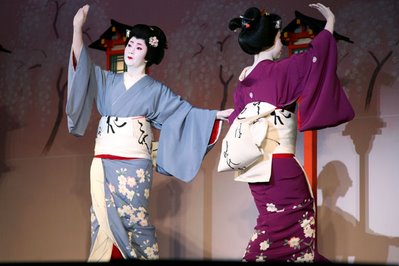
The classic wareshinobu hairstyle of a young maiko on the left is worn during a her first three years of service, until her coming of age ceremony.

Left: Ofuku, worn by maiko from the time of their coming of age ceremony until they are ready to turn their collars and become geiko. Far right: Wareshinobu.

Konomi, close up, is accompanied by Maori, who's wears her own hair styled just as Meiji period schoolgirls once did as part of her Setsubun obake, or costume.

Left: Umemodoki / Osomemage hairstyle. Right: It's a mystery!

Maiko of the Gion Kobu district make their way to the main stage of Yasaka Shrine to participate in the mamemaki, or bean throwing ceremony.


Setsubun festivities at Yasaka Shrine, including dances by Miyagawa-cho, Gion Kobu, and Gion Higashi. Thanks to ericity for uploading it to YouTube!

Unfortunately I was not able to attend the Setsubun festivities this year, but I look forward to shooing away devils and ushering in good fortune next year in Kyoto! Oni wa soto! Fuku ha uchi! If you'd like to Learn more about Setsubun, check out my posts from last year.


Thursday, January 17, 2008

Kurama Fire Festival : 鞍馬の火祭り

Photobucket
One of Kyoto's biggest and most eccentric festivals, Kurama no Hi Matsuri captures the imagination, whisking the awe-struck spectator back in time through an ancient ritual preserved, protected and passed down through the ages to the progeny of an ancient Japan.

Nestled high in northern Kyoto's mountains, the rural town of Kurama consists of traditional, tiled-roof homes and shops crowded along a single main road, narrowly winding its way through the evergreen mountaintops that rise on either side. Each year, on October 22, as the moon begins to rise over these steely blue ridges and night casts its sleepy shadow over the usually quite town, a river of visitors from all over Japan flows from the small, provincial train station, flooding the town in a buzz of anticipation and excitement as they prepare to witness the rites and rituals of Kurama's famous Fire Festival. The Kyoto Shimbun Newspaper numbered the festival-goers in 2008 at over 10,200!


The ancient ritual is rooted in the troubles of the mid Heian Era, when the ancient capital was plagued by rebellion, great earthquakes and natural disasters. In 940, the emperor relocated Yuki Shrine from the grounds of the Imperial Palace north to Kurama in an attempt to appease the northern deities. Bonfires were lit along the road to Kurama, leading the procession of Shinto priests to the deity’s new home. Soon after, the plagues ceased and the rebellion was defeated, once again bringing peace to the empire. The spectacle of the great procession and miraculous virtue of the rites so impressed the people of Kurama that they determined to preserve them for posterity, each generation passing it on to the next.


Today the sacred Shinto rituals begin at 6 pm, but visitors begin arriving long before, seeking out the best places to experience the event and vying to get as close to the action as possible. By the time the sun disappears behind the hills, all open areas along the main road are filled with space-impaired spectators, corralled behind ropes and barriers to keep them a safe distance from the madness that will eventually ensue. Late-comers are ushered behind the early bird crowds by a seemingly infinite number of policemen, politely prodded to keep moving on a continual circuit from the train station, through the town, and back again, past homes and shops with torches of all sizes displayed proudly outside.

Suddenly a cry of "Shinji ni mairasshare!" echoes through the town. At the signal, the citizens of Kurama kindle the torches and small bonfires that line the main street, illuminating the way for the procession of fire.

Photobucket
A silver moon brightens the evening sky above a 3 meter mini-bonfire along the procession route, bound with a shimenawa. A shimenawa is a rope used to cordon off consecrated areas or to act as talisman against evil.

Photobucket
As night falls in high in the mountains, so do the temperatures. Festival-goers take time to warm up around the blazing bonfires, even as sparks and ash falls from the sky.

Tiny toddlers wrapped in brightly colored kimono carry hand held, bottle shaped torches as they are led up and down the main thoroughfare, walking hand in hand with their parents.

Photobucket

Next, small and medium sized torches are shouldered by elementary, junior high and high school boys. Finally, the five meter long taimatsu, or 'great torches', appear, shouldered by the town's young men. The Kurama taiko group, led by a feisty old woman artfully striking a great drum, leads the procession of taimatsu, accompanied by shouts of "Saireya Sairyo"!

Photobucket
A high school students shoulders the tail end of a 5 meter torch as sparks rain down behind him. Catching one of these falling sparks on your skin is said to be very auspicious, if not painful.

These enormous torches weigh over 100 kilos, or 220 pounds.

A group of scantily clad young men show off their "cute hips" in the revealing traditional festival gear.


By 8 pm, over 250 torches are gathered on the great stone steps leading up to Kurama Temple. The heat of the blazing flames can be felt all along the roadside. The shimenawa is cut and the torches are consumed in a massive flame, painting the town in dancing vermillion light that flilckers against the deep, star speckled sky. Two omikoshi, or portable shrines, dance through the streets on the shoulders of Kurama's proud young men, bringing the festival to its climax.


Photobucket
The omikoshi and I with my new friends.


Photobucket


The last train out of Kurama leaves long before the festival draws to an end at midnight, and visitors line up for hours trying to catch one of the few trains back to civilization. My first visit to Kurama no Hi Matsuri was with my friends from Kansai Gaidai, one of whom happened to live a short walk from the festival's epicenter. Long after the tourists had gone, my friends and I drank sake and danced in the street with the townspeople. It is one of the most incredible experiences I've ever had, and for a moment, I felt as if I had experienced a very different Japan, Japan as it must have been long ago. That Japan still exists. You just have to know where to look for it.
You’ll find it in Kurama.

Any Japanese festival is a great place to make new friends!

Monday, December 18, 2006

Gion Odori 2006: Acts Two and Three

Photobucket - Video and Image Hosting

Act Two: Okome. Okome is the Japanese word for rice (before it is cooked). The geiko Mariko, dancing as a Shinto priestess for a plentiful harvest of rice in early spring. In January, maiko wear a stalk of rice in their hair to celebrate the new year.

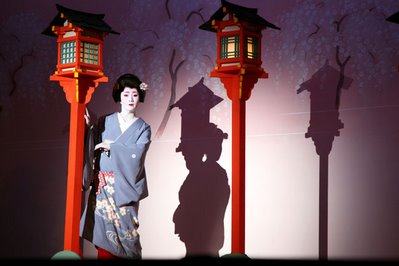
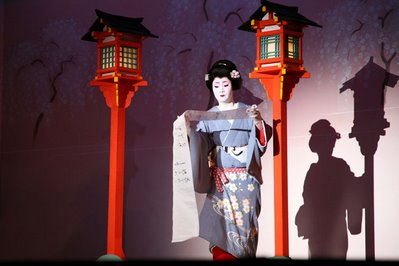
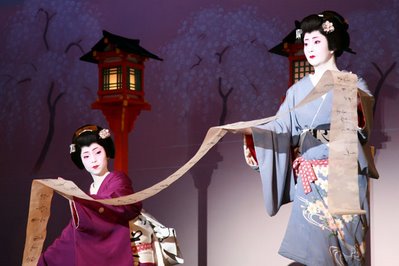
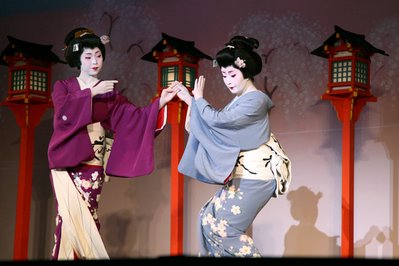
Act Three: Shidarezakura. Shidare zakura (from sakura), or weeping cherry. Before the famous weeping cherries of Maruyama Koen, near Yasaka Shrine, an elder geiko awaits her true love until she is discovered by her younger sister .

Uh oh! She recollectin' ya'll! Reading an unusually long rabureta (love letter) in the absence of her beloved.


I know that correspondence is often recommended to encourage affection, but this is ridiculous sis!

Don't make me...

I love the beautiful bend of their hands, so limber and graceful. It reminds me of the Apsara dance of Cambodia...

Tuesday, November 14, 2006

Misoekai: Miyagawa's Fall Dance

Photobucket - Video and Image Hosting
Kimitomo 君友 peeks out demurely from behind her gold-speckled fan. The extravagant silks, colorful kimonos, flowery hair ornaments and hauntingly beautiful make up are only part of a maiko's beauty, and impressive as they are, the true allure lies in her child-like innocence.

Photobucket - Video and Image Hosting

Photobucket - Video and Image Hosting

Photobucket - Video and Image Hosting
As a geiko, Kimina 君奈 no longer relies on the flashy kimonos or ornate hair ornaments. She has attained a level of skill that speaks for itself with every graceful movement.

Photobucket - Video and Image Hosting

Photobucket - Video and Image Hosting
Harumi 春美

Photobucket - Video and Image Hosting
Kikuryuu 菊柳 perfroming a traditional dance in which awamochi vendors take turns pounding rice cakes as they perform various acts. Awamochi is a type of rice cake that was popular during the Edo Era and is still made today.

Photobucket - Video and Image Hosting

Sunday, November 12, 2006

Pretty in Pink: Miyofuku

Photobucket - Video and Image Hosting

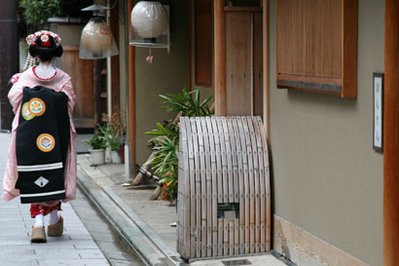
As I stood talking to the old women of Sakuraya, I noticed this young maiko walk past and call at an okiya down the street. After some time had passed, I noticed that she had not yet slipped behind the slit wooden grill of the sliding door, but stood nervously, looking up and down the street. I asked the Okaasan if she was ok, so we walked down to find out. Poor Miyofuku had been locked out of her okiya, and with everyone at rehersals for the fall dance recitals, she didn't know where to go or what do to. Finally Yasuha and Fukuyoshi came by and took her home with them.

Man, I don't know why she didnt just kick off those clogs and climb in through a window! That's what i always used to do when I got locked out (^_<) Hehehe....Just kidding.

Tuesday, November 7, 2006

Meeting the Maiko of Miyagawa

Kimika and Satoai. Check out Kimika's Minnie Mouse purse (^-^) The epitome of traditional Japanese style.

Goro goro goro goro... The unmistakeable sound of a wooden door sliding open. Whenever I find myself strolling through a hanamachi (flower town, where geiko live and entertain), my senses are heightened and alert. Even simple sounds that usually blend into the indistiguishable hum of everday life in Japan, become melodious, distinct, and full of meaning.

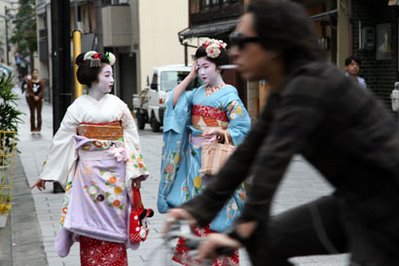
Kobo kobo kobo kobo... Before I could even turn around I heard the soft, giggling voices of two girls and the clop of their tall, hollowed wooden sandals (called Okobo, because of the sound they make) stepping out onto the cement. As I looked over my shoulder, two beautifully dressed maiko came to a stop at busy corner, trying to decide which way to go. The cars and bicyclists, oblivious or uninterested, passed them by without so much as a second glance, but I couldn't take my eyes off them. Behind them a young minarai (apprentice maiko) stood in the street, respectfully seeing her big sisters off. I recognized Kimika (on the left) who has the reputation of being one of the most beautiful maiko in Miyagawa-cho, and was recently featured in Kateigoho Magazine. I watched them turn the corner and disappear, and even after found myself straining to hear the kobo kobo sound of their footsteps fading away. When I came to, I noticed a cute little Japanese woman smiling at me, sweeping the pavement infront of her machiya (townhouse).

"Konnichiwa," I smiled back with a little bow.

"Kawaii, ne? Nihon no maiko-san..." (Cute, aren't they? Japan's maiko)?

"So cute! Beautiful! They're like living works of art. Their hair, their kimono, their make-up, and the way they move... Like a dream!"

"Yes, but it's very difficult, you know. They come from very far away and study very hard. And how about you? You've come quite a way haven't you? Where are you from?"

"America. The State of Ohio. Ohaiyo!" I smiled cheesily and waved my hands in typical school girl fashion (Ohaiyo means 'good morning/ hello' in Japanese).

"Oh, really? Ohio." She said as she laughed at me. "You know, my big sister went to America before. Oh, if she was home I bet she'd love to talk to you. Are you a student? Are you studying abroad? How amazing that you can speak Japanese so well! It's amazing!"

"Actually, I'm an English teacher in Gifu prefecture," I giggled. I get the student thing a lot (I'm not complaining)! "And my Japanese is horrible! I don't study at all...But Thank you for saying so." We stood in the street talking for quite awhile, and eventually she mention that she was 80 years old. 80 years old?! The woman did not look at day over 60, and a young sixty at that. Now that is amazing. It got me thinking, just how old was her big sister?

Yasuha and Fukuyoshi.

As we stood in the street, maiko continued to hurry by. Incapable of hiding my excitement, I fumbled akwardly to get my camera untangled from my neck and bag before they hurried past us. "Oh, that's good!" She said. "We'll take a picture!"

"What? No, no, that's Ok! They're busy and..."

Before I could refuse she was already calling to Yasuha, by name. To my suprise, Yasuha greeted her with a big smile, a bow and bubbley "Konnichiwa Okaasaan!" The little old woman asked her if she could take our picture, directed Yasuha to stand in front of a teahouse across the street, and pushed me over to her as she grabbed my camera out of my hands.
Yasuha and I (^-^)v

I apologized and thanked Yasuha about 3 times in one breath, even as I tried to smile for the picture. "Hai cheeezu!" She called out. "Ah! That one was no good. One more! Hai Cheezu! Ok!"

I started to apologize and thank Yasuha all over again, but she smiled, bowed to me, said "Ookini" (thank you in Kyoto dialect).

Photobucket - Video and Image Hosting

As Yasuha walked up the street, a little old woman leaning on her cane came around the corner. Yasuha greeted her and bowed, stopping in her steps and turning to face the old woman as she slowly hobbled on by. "Oh! Here she is! This is my big sister. Big sister! This cute little sister is from America! It's amazing. She can speak English and Japanese!"

The big sister, who turned out to be 84, slowly made her way to me with a beautiful smile spread across her softly wrinkled face. She asked me where I was from and if I was a student, and then we began to talk about her trips to America at least 40 years ago. She had been to L.A., San Fransisco, Las Vegas and the Grand Canyon. "It was amazing. I had never seen so many fruits. Such beautiful fruit!"

"Really?" I asked "Was the fruit delicious?"

"Oh, I don't know...I never got to eat any. I was with a customer. You know we can't eat when we're with a customer like that. But I remember thinking, "What beautiful fruit!" I had never seen anything like that before!"


The maiko were still making there way back and forth, calling at okiyas and hurrying to get to the recital practice. All of them greeted this wonderful little woman with deep bows of respect and sweet sounding "Konnichiwa Okaasaan!" and then would smile at me a give a little bow. She often asked them to stop for me to take a picture, or tried to talk to them long enough until I seemed satisfied with the shot I had. "Did you get it?" She asked when they would clop clop away down the little alley just next to her home.


We talked for quite awhile before she called for her little sister to bring something out for me. She emerged, hiding her smile behind a classic Gion Matsuri uchiwa (Japanese style fan) with the name of Miyagawa's most acclaimed dancer written elegantly beside the crest of the hanamachi. She place a "Sakura-ya" sticker (name card, like geiko use) near the base of the smooth wooden handle. "This is my place. Sakura-ya." I thanked her profusely before she slipped into the sliding door of her home, content with the events of the day and the experience they had brought me. It wasn't even noon yet.

Miyoharu and Fukuhina outside their okiya. Conveniently placed, ubiquitous vending machines.

A Stroll Through Miyagawa-cho

With October drawing to an end, I was determined to make a quick trek to Kyoto to secure tickets for Gion Odori, Gion Higashi's fall dance recital. I hadn't been to Kyoto since Gion Matsuri, and after three months I was itching for an excuse to get back.
Kyoto, like the rest of Japan, has been burried beneath a net of tangled electrical wires and encased in concrete. As I pulled into the station, staring out the smudged windows of the train, I wondered how I would have felt if this had been my first view of the old capital. Many foreigners must feel extrememly disappointed upon arriving in Kyoto, expecting to find old Japan, untouched by the rapid westernization consuming the world. Yet it is in the cracks and crevices of this seemingly cold, colorless, modern metropolis that the wonders of the ancient capital strive to survive, and wait to be discovered.

Kyoto has been my home away from home (away from home) since the first time I stumbled up the stairs of the Shijo Keihan subway station (after being stopped by a tiny little Buddhist nun who smiled and bowed and pinched my nose saying "Kawaii ne! Hana takai ne!" (Well aren't you cute? And your nose is so high!), and out onto the busy street, lined on one side by the Kamogawa River and the famous Minamiza Kabuki Theatre on the other. I know it better than the city I have been living in these past 2 and a half years, and probably know more about it than my hometown in the US. So as I weaved my way through the traffic of Japanese tourists filling crowded Kyoto station, I felt strangely enough as if I was home.

I walked along the Kamogawa River, wondering where the day would lead me. I always follow the river up to a certain point before loosing myself in the narrow lanes of Miyagawa-cho, one of Kyoto's five flower districts, where geiko live and entertain. I never expect to see much during the daytime-- perhaps a young maiko on the way to her lessons, casually dressed in a simple kimono-- but just walking through the quiet streets, lined with intricate wooden facades of ochayas (teahouses) and okiyas (where geiko live) is more than enough to make me happy. If I'm lucky, I'll hear an older geisha singing as she practices her shamisen, or see a maiko dressed for an appointment hurry into a taxi or down a narrow alleyway. These simple moments, when I am able to see my life in the light of a haiku, are what keep me madly in love with Kyoto.

The streets seemed quiet enough. It was still early, before noon, and little old women were washing down the concrete in front of their homes. The old man from the tiny little home-front market hurried back and forth across the street carrying big boxes of perssimons and apples, shouting out "Ookini!" to someone hidden in the shadows of his little shop. My eyes focused on the nameplates hung near the entrance of the okiyas, trying to decipher the kanji in the names of the maiko and geiko living there, until a sudden flash of intense color in the otherwise dull distance caught my eye. A maiko sliding out of her okiya and down the street, her long, trailing obi fluttering above her high wooden sandals, appeared like an apparition from another age. "What a great way to start the day," I thought as I watched her disappear into another teahouse, smiling to myself, happy to be "home".

Thursday, November 2, 2006

Miehinna

Photobucket - Video and Image Hosting
Miehinna, a beautiful young maiko from Miyagawa-cho.

I had an amazing adventure in Kyoto last weekend. I promise to tell you all about it and get the rest of my pictures up soon! Gomen ne m(- -)m

Thursday, August 3, 2006

The Flower Procession: Gion Matsuri

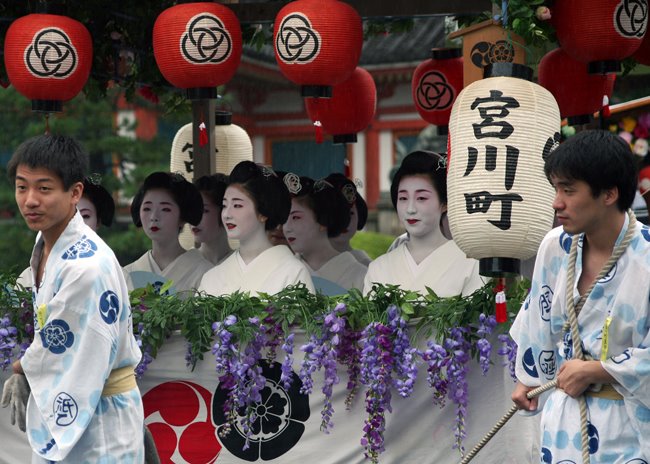
Maiko from Miyagawa-cho being pulled through Kyoto by young men from their neighborhood.
I'm sure you're all sick of seeing pictures from Gion Matsuri, but I just can't help myself! I'll try to write more later...Until then just enjoy the view from here (^_<)

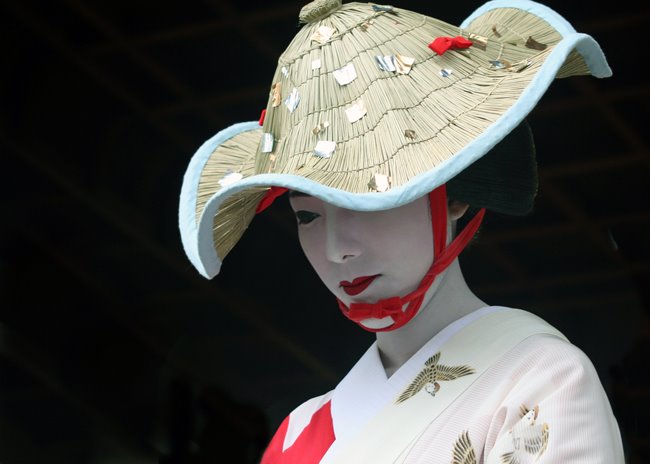
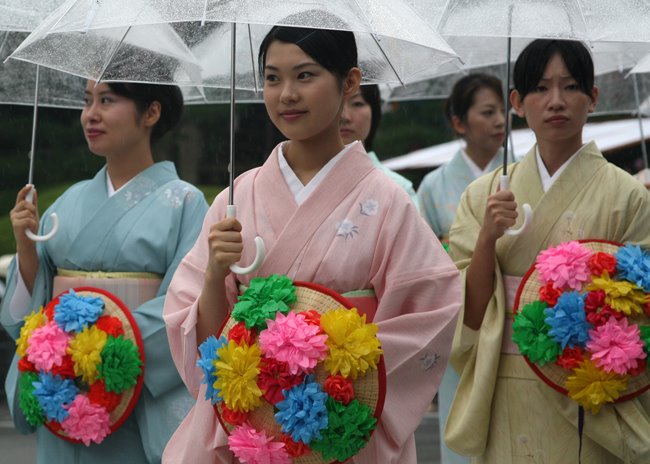
Young women carrying their hanagasa, straw hats covered with fake paper flowers, seek shelter beneath their umbrellas.

Kanazuru, a maiko from Miyagawa-cho.

A young White Herron Dancer giggling as she ran for cover from the relentless rain.

A maiko from Gion.

A shrine maiden of Yasaka Jinja tries to keep her hanagasa in place.